Purpose Collective / The Lighthouse
The Lighthouse Purpose Framework
A model for understanding how what we inherit, learn, imagine, choose, experience, and revise shapes the life we believe is worth living.
Purpose is often discussed as if it were a single answer waiting to be discovered. The Lighthouse Purpose Framework begins from a different premise: human beings make decisions with incomplete information. At every point in life, we interpret ourselves and imagine our future using the knowledge, beliefs, experiences, relationships, responsibilities, opportunities, abilities, and constraints available to us at that time.
We then make choices. Those choices create experiences. Experience produces new information. New information can reinforce, challenge, or reorganize what we previously believed mattered.
The framework explores that evolving process.
01
Purpose is not found once. It is clarified through living.
The Lighthouse Purpose Framework treats purpose as an evolving field rather than a fixed destination.
A person does not arrive in adulthood with complete knowledge of who they are, what they value, what they are capable of, or what kind of life will ultimately feel meaningful.
Instead, we build an understanding of those things over time.
We learn.
We imagine.
We choose.
We experience the consequences of those choices.
We reflect.
And sometimes we change.
A career that once represented success may later feel like a tool for creating freedom. A relationship may introduce responsibilities that did not exist before. Parenthood may reorganize priorities. Loss may challenge beliefs. Education may reveal possibilities that previously did not exist in someone's imagination. Success itself may reveal that the thing once pursued was not as fulfilling as expected.
The framework is designed to help map those changes rather than pretend purpose is always one permanent answer.
Framework Architecture
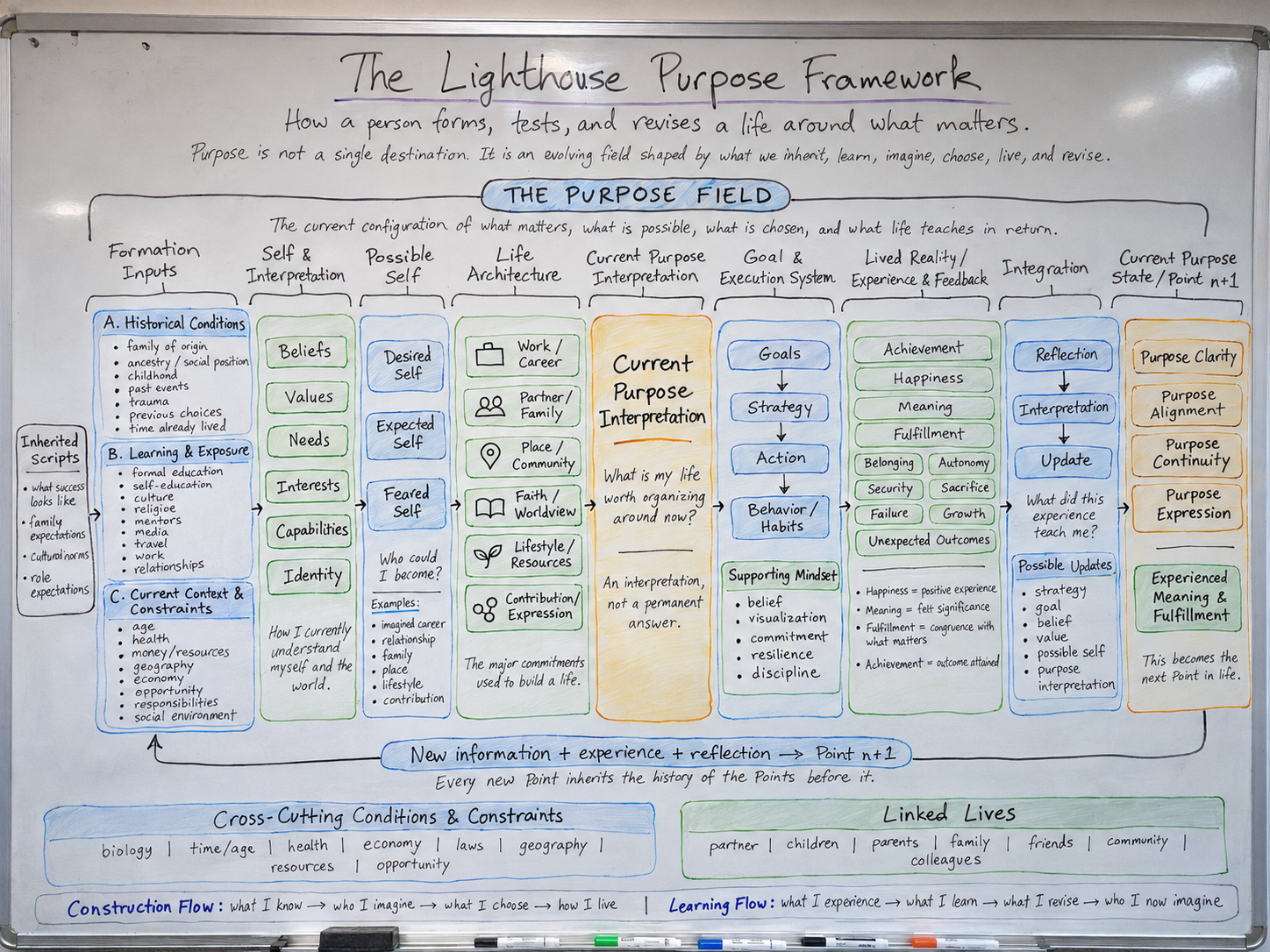
The complete framework at a glance.
The Lighthouse Purpose Framework maps the major forces that shape what a person believes is worth living for — and how those forces interact across a lifetime.
Swipe to explore the full framework →
How It Moves Through a Life
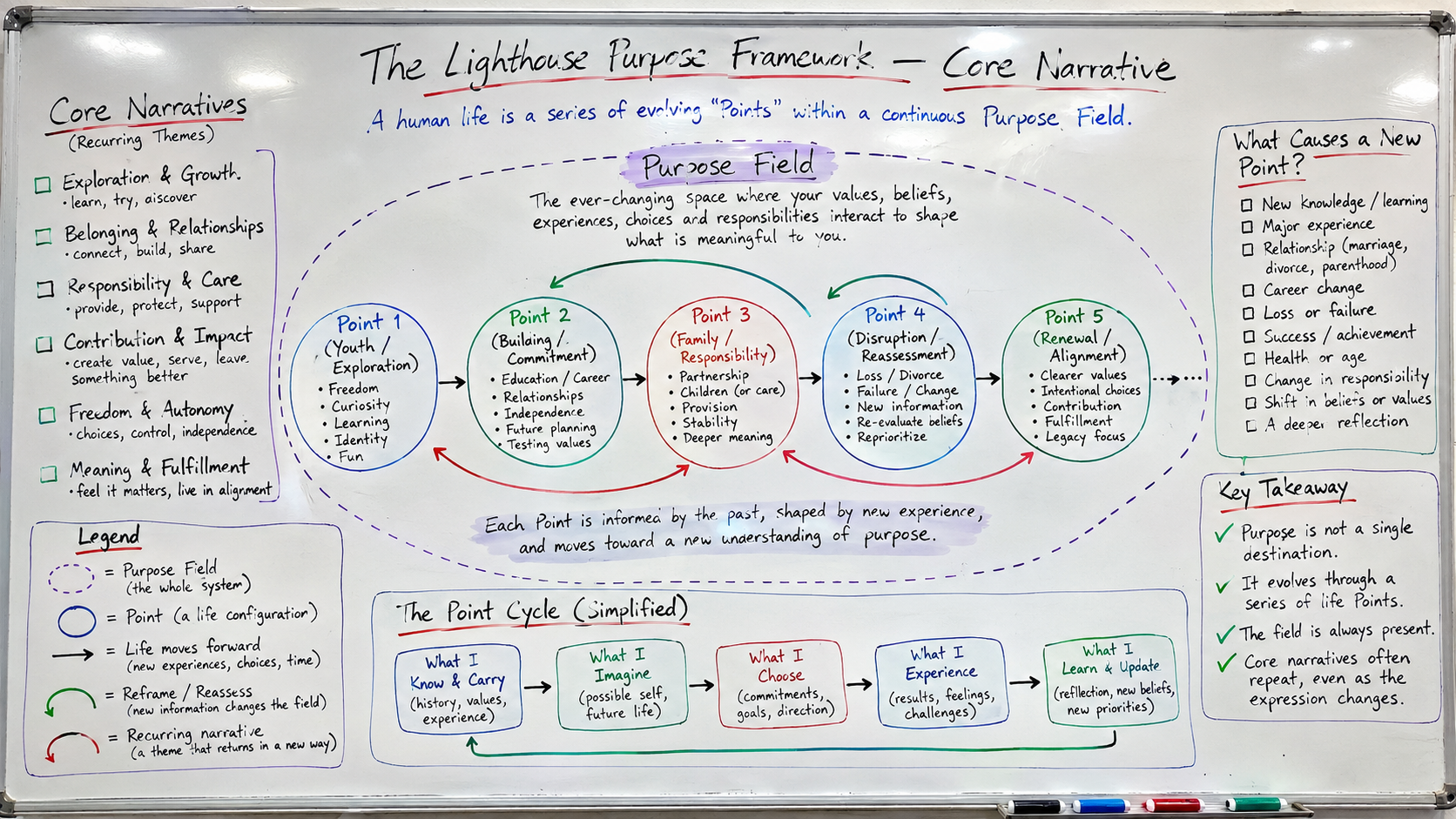
Points, reassessment, and the narratives that recur.
Purpose does not move in a straight line. The Core Narrative shows how a person passes through distinct life Points — each shaped by new information, changing circumstances, and the recurring themes that define a human life.
Swipe to explore the full framework →
02 / The Purpose Field
Purpose is larger than any single goal.
A person's career is not their entire purpose.
Neither is marriage.
Money is not purpose.
A goal is not purpose.
Happiness is not purpose.
Even fulfillment, meaning, and purpose should not be treated as interchangeable words.
The Lighthouse Purpose Framework uses the term Purpose Field to describe the larger system in which these forces interact.
Purpose Field
The current configuration of everything influencing what a person believes matters, who they believe they are, who they imagine they could become, what they choose to pursue, and what makes their life feel worth living.
The field exists whether or not a person can clearly explain their purpose.
Someone may have low Purpose Clarity and still have strong values, meaningful relationships, responsibilities, ambitions, recurring interests, and a future they are trying to build.
Purpose is therefore not treated as one object sitting inside the field.
The person's understanding of purpose emerges from the interaction of the field.
01
What I Arrived Carrying
Historical conditions that already belong to the life.
- –Family of origin
- –Ancestry
- –Birthplace
- –Childhood
- –Culture
- –Past experiences
- –Previous decisions
- –Losses
- –Trauma
- –Time already lived
These conditions cannot simply be rewritten as if they never happened. Their influence and meaning, however, may change.
02
What I Have Learned
Information that expands the person's map of reality.
- –Formal education
- –Self-education
- –Parents
- –Mentors
- –Religion
- –Books
- –Media
- –Travel
- –Work
- –Relationships
- –Community
- –Direct experience
Learning changes what a person knows is possible.
03
What Currently Exists Within Me
The person's current internal configuration.
- –Beliefs
- –Values
- –Needs
- –Interests
- –Identity
- –Knowledge
- –Capabilities
- –Health
- –Confidence
These elements influence how the same external situation may be interpreted differently by different people.
04
What I Can Imagine
The Possible Self and Possible Future.
- –Who I want to become
- –Who I believe I could become
- –Who I fear becoming
- –Career
- –Relationships
- –Family
- –Location
- –Lifestyle
- –Contribution
Human beings often make major decisions toward futures they have never actually lived.
05
What I Choose
The commitments used to construct the imagined future.
- –Education
- –Career
- –Partner
- –Family structure
- –Place
- –Worldview
- –Goals
- –Projects
- –Lifestyle
- –Contribution
Choices turn the imagined future into a lived experiment.
06
What Life Gives Back
The consequences and experiences produced by those choices.
- –Achievement
- –Happiness
- –Meaning
- –Fulfillment
- –Belonging
- –Autonomy
- –Security
- –Sacrifice
- –Frustration
- –Failure
- –Growth
- –Unexpected outcomes
Reality gives the person information that imagination alone could not provide.
The Purpose Field is always present, but its configuration is never permanently fixed.
Experience changes the field because life continually gives us information that we did not possess before.
Four Terms Worth Distinguishing
Happiness
A positive subjective experience or evaluation of how life feels.
Happiness can be important feedback, but temporary happiness alone does not prove that something represents a person's purpose.
Meaning
The experience that something matters, makes sense, or connects to something larger than the immediate moment.
Fulfillment
The deeper experience that what someone is living feels congruent with what they consider important.
A goal can be achieved without producing fulfillment.
Purpose
The higher-order orientation around what a person currently believes is worth organizing life around.
Purpose can generate goals, but a goal alone does not define purpose.
03 / Points
"I'm at a point in my life where…"
People say this naturally because the priorities, possibilities, responsibilities, and beliefs shaping a life do not remain identical forever.
Someone might say:
“I’m at a point where family matters more.”
“I’m at a point where I want to build something of my own.”
“I’m at a point where I no longer care about impressing people.”
“I’m at a point where I need to begin again.”
The Lighthouse Purpose Framework uses Point in a specific way.
Point
A temporary configuration of a person's Purpose Field at a particular period of life.
A Point describes:
- –Who I currently understand myself to be
- –What I currently know
- –What I currently believe
- –What I currently value
- –What capabilities and limitations I currently have
- –What responsibilities I currently carry
- –What future I can currently imagine
- –What I am currently pursuing
- –What life is currently teaching me
One person. Different Points.
A person can carry the same history while experiencing very different configurations of values, responsibilities, beliefs, capabilities, goals, and imagined futures at different moments in life.
Point A
Current configuration
- Beliefs
- Values
- Knowledge
- Responsibilities
- Possible Self
- Goals
New Experience / Information
education
relationship
success
failure
loss
new responsibility
reflection
Point B
Updated configuration
- Some beliefs remain
- Some priorities change
- New responsibilities
- New Possible Self
- Revised goals
New Experience / Information
Point C
Another updated configuration
- Inherited history
- Evolved values
- Changed circumstances
- New imagination
- New direction
A Point is not an age bracket.
Someone does not enter Point B because they turn thirty.
A Point changes when new experience or information meaningfully changes part of the Purpose Field.
That might come from:
Not every Point transition changes everything.
Strategy changes
The purpose and goal may remain, but the method changes.
Goal changes
The deeper value remains, but the target changes.
Belief changes
New information challenges what the person previously assumed was true.
Value priority changes
A value does not necessarily disappear, but another becomes more important.
Possible Self changes
The person imagines a different future.
Purpose Interpretation changes
The person begins organizing life around something different.
What Cannot Simply Be Undone
- –Family of origin
- –Ancestry
- –Birthplace
- –Time already lived
- –Past events
- –Previous choices
- –Losses
- –Historical circumstances
The event may be irreversible.
What Can Continue to Develop
- –Beliefs
- –Values
- –Knowledge
- –Capabilities
- –Relationships
- –Goals
- –Career
- –Location
- –Worldview
- –Confidence
- –Purpose Interpretation
Its meaning and influence may still change.
The Lighthouse Purpose Framework therefore avoids a simplistic division between "changeable" and "unchangeable." Human life contains both inherited constraints and adaptive possibilities.
What changes matters. What keeps returning matters too.
Across different Points, some themes may repeatedly reappear.
Someone's careers may change while teaching continues to appear.
Their goals may change while freedom remains underneath them.
Their responsibilities may change while service remains central.
The framework calls these recurring themes: Purpose Continuity.
How We Begin Building a Life
We inherit a model, imagine a future, and begin making choices.
01 / Inherited Scripts
What was I taught a good life should look like?
Family, culture, religion, education, peers, and society give us expectations about success, work, relationships, responsibility, and adulthood.
These expectations are not automatically wrong. But they are not automatically our values either.
Part of Purpose Clarity is learning which expectations became genuinely ours.
02 / Possible Selves
Who can I imagine becoming?
We form images of who we want to become, who we expect to become, and who we fear becoming. These imagined futures influence real decisions long before we have experienced the life we are choosing.
A child who wants to become an astronaut may know little about the actual profession, but the dream may already represent exploration, science, adventure, or discovery.
The future we imagine is limited by the information currently available to us.
03 / Life Architecture
What choices am I making to build that imagined future?
Career, marriage, money, and location are not purpose. They are structures through which a person attempts to build a life that reflects what currently matters.
From Purpose to Direction
What is my life worth organizing around now?
At any Point, a person may develop a current interpretation of what matters enough to organize life around.
The framework calls this a Purpose Interpretation.
Purpose
Why does this matter?
Goal
What am I trying to make true?
Goal: Join the military.
Possible reasons underneath it:
Life Answers Back
Then the imagined life becomes a lived one.
Every major choice begins with some expectation about what it will give us.
–A career may promise achievement.
–A relationship may promise belonging.
–Money may promise freedom.
–A move may promise a different lifestyle.
–A goal may promise fulfillment.
Eventually, imagination meets experience.
Sometimes life confirms what we expected.
Sometimes achieving the goal reveals that we misunderstood what we wanted.
Sometimes failure exposes a better direction.
Sometimes new responsibilities change what matters.
Sometimes nothing fundamental changes at all.
And another Point begins.
The framework does not promise one permanent answer.
It offers language for reflection at any Point.
Purpose Clarity
How clearly do I understand what matters to me and why?
Purpose Alignment
Does the life I actually live reflect what I say matters?
Purpose Continuity
What themes keep returning across different Points?
Purpose Expression
How am I currently living those themes?
Research Foundation
Ideas that informed the framework
Possible Selves
How imagined versions of ourselves influence motivation and future behavior.
Life-Course Theory
How human lives develop through transitions, timing, social context, agency, constraints, and linked lives.
Narrative Identity
How people construct and revise stories connecting past, present, and imagined future.
Self-Determination Theory
How autonomy, competence, and relatedness influence motivation and well-being.
Self-Concordant Goals
How goals aligned with personal interests and values can produce stronger sustained effort and well-being.
Goal-Setting Theory
How specific goals can direct attention, effort, persistence, and strategy.
Meaning-in-Life Research
Research distinguishing purpose, coherence, and significance as related dimensions of meaning.
The Lighthouse Purpose Framework is an original integrative conceptual model. It is not currently a validated psychological assessment, clinical instrument, or established scientific theory.
A lighthouse does not choose your destination.
A lighthouse does not control the ocean.
It does not remove storms.
It does not decide where the ship must go.
It provides orientation.
The Lighthouse Purpose Framework is designed to do the same. It helps you ask:
Where am I now?
What shaped this Point?
What future am I trying to build?
What is life teaching me?
What keeps appearing across different Points?
Given what I know now, where do I want to navigate next?
Continue the Inquiry
Where do you want to go next?
Explore the Ideas
Read the essays behind the framework.
The Lighthouse and Purpose Collective essays investigate identity, meaning, mindset, purpose, human behavior, and the questions behind the framework.
Read Purpose Collective →Apply It to Your Own Life
Book a private Purpose Collective conversation.
If you are at a Point where your direction, priorities, goals, or next chapter need deeper examination, book a private Purpose Collective conversation.
Book a Conversation →A guided Lighthouse Purpose Mapping resource is in development.